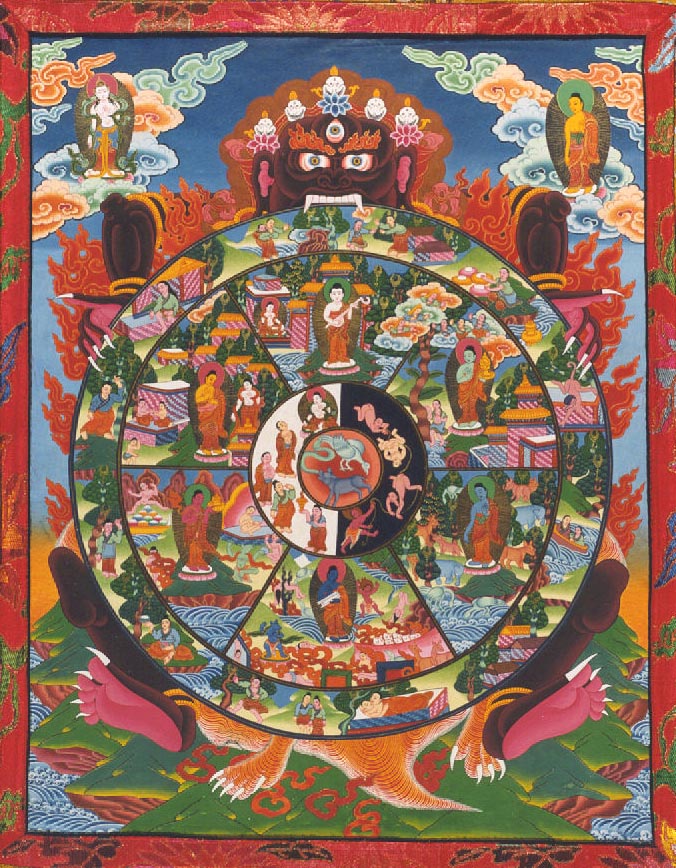
Bhavacakra
University of Idaho Library
My dear friends,
In Tibetan Buddhist iconography, the bhavachakra ("Wheel of Existence") is frequently represented as being engulfed in flame. This metaphor was first employed by the Buddha in his "Fire Sermon":
the Blessed One was staying in Gaya,
at Gaya Head, with 1,000 monks.
There he addressed the monks:
"Monks, the All is aflame..."
"...Aflame with what?
Aflame with the fire of passion,
the fire of aversion,
the fire of delusion.
Aflame, I tell you,
with birth, aging, and death;
with sorrows, lamentations, pains,
distresses, and despairs."
"Adittapariyaya Sutta: The Fire Sermon" (SN 35.28).
Translated from the Pali by Thanissaro Bhikkhu.
Access to Insight, 30 November 2013.
In the previous lesson we learned that tanha, or craving, is the immediate cause of dukkha (suffering). The Buddha now asks us to look even deeper. Craving does not arise without causes of its own. Like smoke rising from a fire, craving is the visible expression of three more fundamental forces within the mind: ignorance, attachment, and aversion. These are known as the Three Poisons, for they distort our experience of reality and give rise to the craving that perpetuates suffering.
The eye is aflame. Forms are aflame.
Consciousness at the eye is aflame. Contact at the eye is aflame....
The ear is aflame. Sounds are aflame...
The nose is aflame. Aromas are aflame...
The tongue is aflame. Flavors are aflame...
The body is aflame. Tactile sensations are aflame...
The intellect is aflame. Ideas are aflame....
"And whatever there is that arises in dependence on contact...
-- experienced as pleasure, pain or neither-pleasure-nor-pain --
that too is aflame."
"Adittapariyaya Sutta: The Fire Sermon" (SN 35.28).
Translated from the Pali by Thanissaro Bhikkhu.
Access to Insight, 30 November 2013.
When the Buddha declares that "the eye is aflame," he is not condemning our senses or the physical world. Rather, he is describing the way ordinary experience is conditioned. Sight, sound, smell, taste, touch, and thought all arise through causes and conditions, but our encounter with them is continually colored by ignorance, attachment, and aversion. Thus even experiences that begin as pleasant, painful, or neutral feelings can become occasions for craving, grasping, resistance, and ultimately suffering. The "fire" is not in the world itself, but in the way the unenlightened mind responds to it.
We have already seen how experience unfolds through the five skandhas. Contact gives rise to sensation, sensation to perception, perception to consciousness, and consciousness may lead to intentional action. Throughout this entire process, the mental formations—our memories, habits, instincts, and conditioned patterns of thought— continually influence every stage. When these mental formations are dominated by ignorance, attachment, and aversion, the whole process becomes "aflame" with afflictive emotions (kleshas) such as fear, hatred, arrogance, jealousy, anger, greed, possessiveness, and despair.
Not only are these emotions mentally (and sometimes even physically) painful, they can lead to "unskillful actions" (akusala-kamma) that are harmful to others as well as ourselves. These harms, by propagating through the social, political, economic, and natural environment, can loop back and bite us from behind, causing additional suffering:
Burns like a red coal carpet / Mad bull lost its way
-- The Rolling Stones, Gimme Shelter, 1969
Your samsara is the continuation of your contaminated aggregates.
-- Gelek Rimpoche
Gelek Rimpoche summarizes the Buddha's teaching with striking clarity: "Your samsara is the continuation of your contaminated aggregates." The five skandhas are not themselves the problem; they are simply the process through which experience unfolds. Suffering arises because this process has become contaminated by the Three Poisons. Like a fire that spreads from one burning object to the next, ignorance gives rise to attachment and aversion, these give rise to craving, craving gives rise to intentional thoughts and actions, and those actions produce further consequences that reinforce the very habits that created them. Thus the fires of samsara, the world of suffering, sustain themselves from one moment to the next.
The Fire Sermon reveals that the world of samsara is not condemned to burn forever because of anything inherent in the senses or the world itself. The fires are sustained by ignorance, attachment, and aversion within our own minds. If these causes can be understood and transformed, then craving need no longer arise, suffering need no longer continue, and the fires can at last be extinguished.
In our next lesson we will turn to the Third Noble Truth, in which the Buddha proclaims this astonishing possibility: the cessation of dukkha. Like a fire that goes out when its fuel is exhausted, the fires of greed, hatred, and delusion can also be extinguished, revealing the peace and freedom of nirvana.