
Saying Grace
Cornelis Pietersz. Bega, 1664
My dear friends,
The eighth chapter of Paul's letter to the Romans reaches toward a confidence that surpasses ordinary hope. He speaks from within a life marked by suffering, perseverance, and profound communion with Christ. Those who walk the Bodhisattva path can hear these words as an invitation to awaken the mind of boundless compassion. Where Paul speaks of the Holy Spirit, we may recognize the living activity of bodhicitta: the love, compassion, and wisdom that arise beyond the grasping self and continually draw beings toward liberation. The language differs, yet both traditions point toward a transforming presence that guides us beyond fear into self-giving love.
for we do not know how to pray as we ought,
but that very Spirit intercedes
with groanings too deep for words.
And God, who searches hearts,
knows what is the mind of the Spirit,
because the Spirit intercedes for the saints
according to the will of God.
- Romans 8:26-27
Many practitioners become discouraged because their meditation feels distracted or their prayers seem empty. Paul offers deep encouragement. The deepest movement toward awakening does not depend upon our ability to manufacture perfect thoughts or emotions. When the self relaxes its anxious striving, the compassionate intention to benefit all beings continues its work beneath conceptual thought. The "groanings too deep for words" resemble the silent aspiration of bodhicitta, arising before language and carrying the heart toward union with divine love. Every sincere return to compassion, however feeble it appears, becomes participation in this deeper current.
who are called according to his purpose.
For those whom he foreknew he also predestined to be conformed to the image of his Son,
in order that he might be the firstborn within a large family.
And those whom he predestined he also called,
and those whom he called he also justified, and those whom he justified he also glorified.
- Romans 8:28-30
From the perspective of the Bodhisattva path, this passage describes the gradual transformation of a human life into a faithful reflection of divine compassion. Paul speaks of conformity to the image of Christ. Lam rim teachings describe a progressive training that culminates in Buddhahood for the benefit of all beings. Both invite wholehearted trust that every joy and hardship can become material for awakening when received with wisdom, ethical discipline, and loving service. Even painful experiences become causes for greater compassion when they soften the heart rather than harden it.
If God is for us, who is against us?
He who did not withhold his own Son but gave him up for all of us,
how will he not with him also give us everything else?
- Romans 8:31-32
Paul's confidence rests upon the inexhaustible generosity revealed in Christ. The Bodhisattva likewise entrusts himself completely to the inexhaustible generosity of awakened compassion. Confidence grows through repeated experience that every genuine act of self-giving aligns our lives more deeply with reality. Fear gradually loses its authority because love has become the governing intention of the heart. Such confidence supports courageous service without attachment to success or recognition.
It is God who justifies.
Who is to condemn?
It is Christ who died, or rather, who was raised,
who is also at the right hand of God,
who also intercedes for us.
- Romans 8:33-34
The accusing voice of self-judgment often proves more relentless than criticism from others. Lojong training encourages practitioners to acknowledge faults honestly while abandoning the habit of defining themselves by them. Paul directs our attention toward Christ's continual intercession, revealing that divine compassion meets our failures with healing rather than rejection. Repentance then becomes joyful participation in grace, opening the heart to renewed commitment instead of despair.
Will affliction or distress or persecution or famine or nakedness or peril or sword?
As it is written, "For your sake we are being killed all day long;
we are accounted as sheep to be slaughtered."
No, in all these things we are more than victorious through him who loved us.
- Romans 8:35-37
Neither the Christian disciple nor the Bodhisattva measures spiritual progress by the absence of hardship. Both expect compassion to mature through adversity. Every encounter with illness, persecution, loss, or disappointment becomes an opportunity to deepen patience, courage, and loving concern for others who suffer similarly. Victory therefore means remaining rooted in love amid changing conditions, allowing affliction to expand rather than diminish the heart.
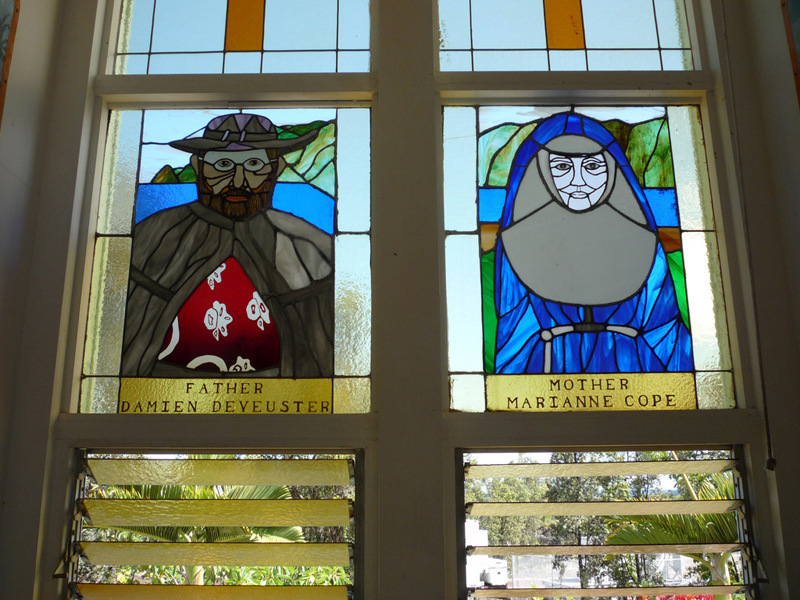
Father Damien and Mother Maryanne
Star of the Sea Painted Church, 1980
nor angels, nor rulers,
nor things present, nor things to come,
nor powers, nor height, nor depth,
nor anything else in all creation
will be able to separate us from the love of God
in Christ Jesus our Lord.
- Romans 8:38-39
Paul concludes with one of Scripture's most profound affirmations of inseparable love. The Bodhisattva path likewise trusts that ultimate reality is inseparable from boundless wisdom and compassion. Delusion may obscure this truth for a time, yet it cannot extinguish it. As attachment and aversion gradually dissolve through contemplation and compassionate action, we discover that the love revealed in Christ has quietly accompanied us throughout every stage of the journey. Abiding in that love, we naturally become instruments through whom others also discover hope.
May we welcome the Spirit of Christ as the awakening of bodhicitta within our own hearts. May every prayer, every meditation, every act of service, and every moment of suffering become a step along the path of self-emptying love. As we entrust ourselves ever more completely to divine compassion, may we grow into the likeness of Christ, dedicating whatever wisdom and merit arise to the liberation, healing, and flourishing of every living being.