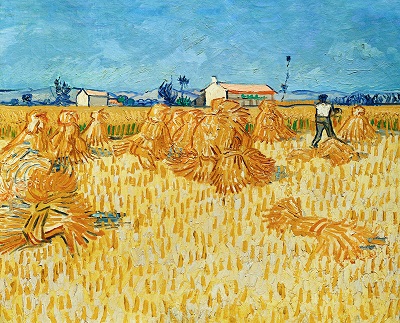
Harvest in Provence
Vincent van Gogh, 1888
My dear friends,
Today's Gospel begins with Jesus looking upon a suffering world and responding with compassion. He sees people who are lost, burdened, and in need of guidance. Yet he does not stop at feeling compassion. He acts. He teaches, heals, and sends others to continue the work. This movement from compassion to action lies at the heart of both the Gospel and the Bodhisattva path. The Bodhisattva, like Christ, does not seek liberation for oneself alone, but dedicates one's life to relieving suffering wherever it is found. As we reflect upon these words of Jesus, we are invited to consider what it means to become laborers in the harvest of compassion.
teaching in their synagogues and proclaiming the good news of the kingdom
and curing every disease and every sickness.
- Matthew 9:35
Jesus does not remain in a place of comfort waiting for others to come to him. He travels among the people, bringing wisdom where there is confusion and healing where there is suffering. In the Mahayana tradition, this is one of the defining characteristics of a Bodhisattva. Compassion is not merely a feeling; it takes the form of skillful action. Whether through teaching, listening, encouraging, feeding, healing, or simply being present, the Bodhisattva seeks to bring benefit to others wherever circumstances allow.
because they were harassed and helpless, like sheep without a shepherd.
- Matthew 9:36
The source of Jesus' ministry is compassion. He sees the suffering of others and allows their suffering to touch his heart. This is very close to what Buddhism calls great compassion (mahakaruna), the heartfelt wish that all beings be free from suffering and its causes. The Bodhisattva path begins not with doctrine but with this transformation of vision. Instead of seeing strangers, competitors, or obstacles, we begin to see fellow beings who, like ourselves, seek happiness yet often become trapped by fear, ignorance, and craving.
therefore ask the Lord of the harvest to send out laborers into his harvest."
- Matthew 9:37-38
The harvest is plentiful because suffering is plentiful. Everywhere there are opportunities to relieve pain, encourage hope, teach wisdom, and cultivate peace. Yet those willing to dedicate themselves to such work are always too few. Jesus calls for laborers. The Mahayana tradition calls for Bodhisattvas. Both traditions recognize that compassion must be embodied in people who are willing to serve. The field is the world itself, and every act of kindness becomes a seed planted in the harvest of awakening.
and gave them authority over unclean spirits, to cast them out,
and to cure every disease and every sickness.
- Matthew 10:1
Before sending the disciples, Jesus empowers them. In the same way, the Bodhisattva path teaches that good intentions alone are not enough. One must cultivate the qualities that make compassionate action effective. Generosity, ethical conduct, patience, perseverance, concentration, and wisdom are all forms of spiritual training. As these qualities mature, we become better able to respond to suffering without becoming overwhelmed by it ourselves.
"Do not take a road leading to gentiles, and do not enter a Samaritan town,
but go rather to the lost sheep of the house of Israel."
- Matthew 10:5-6
At this point in Matthew's Gospel, the mission begins with those nearest at hand. While the compassion of Christ ultimately embraces all nations, the work starts with the people immediately before him. The Bodhisattva path follows a similar principle. Our aspiration extends to all beings everywhere, yet our practice begins with those whose suffering we can actually encounter. Compassion grows outward from concrete acts of care toward family, neighbors, community, and eventually the whole world.
'The kingdom of heaven has come near.'"
- Matthew 10:7
The disciples are sent not only to help but also to proclaim a new reality. The kingdom of heaven has come near. From a Bodhisattva perspective, we might say that awakening is closer than we imagine. Whenever wisdom overcomes ignorance, whenever compassion overcomes selfishness, whenever reconciliation overcomes division, the reality to which Jesus points becomes visible. The kingdom is not merely a future destination; it begins to manifest wherever hearts are transformed by love.
You received without payment; give without payment."
- Matthew 10:8
The disciples are instructed to heal, liberate, and give freely. They are not to seek wealth, status, or recognition for their service. They have received God's gifts freely and are called to share them freely. The Bodhisattva ideal expresses the same spirit. Whatever wisdom, resources, talents, or opportunities we possess are not ultimately our own. They become instruments for benefiting others. Compassion is most powerful when it is offered without calculation and without expectation of reward.
The Gospel invites us to see the world through the eyes of Christ: to recognize suffering, to allow compassion to arise, and then to act. The path from compassion to service is the path walked by Jesus and, in many ways, the path walked by the Bodhisattvas. The harvest remains plentiful. There are still wounds to heal, burdens to lift, and hearts to encourage. May we therefore become laborers in that harvest, dedicating our lives to the welfare of all beings and helping to bring God's kingdom of compassion ever nearer to the world.