My dear friends,
Isaiah 25:6-9 invites us to imagine a feast prepared for all peoples, a shroud lifted from all nations, and tears wiped from every face. From the viewpoint of the Bodhisattva path, this vision speaks to our aspiration that all sentient beings be freed from suffering and its causes. Might the prophecy be nearly fulfilled in our own time, when the spiritual inheritance of millennia is increasingly accessible? We can recognize something of the promised feast in this abundance, while remembering that access to wisdom and realization of wisdom are different things. Isaiah proclaims God’s deliverance; the Buddhist path teaches the cultivation of wisdom and compassion. Their meeting here is a contemplative conversation, allowing each tradition to illuminate our responsibility toward those who suffer.
a feast of rich food, a feast of well-aged wines,
of rich food filled with marrow, of well-aged wines strained clear.
- Isaiah 25:6
The rich food and well-aged wines suggest nourishment patiently brought to maturity. We may see in them teachings preserved, tested in practice, and clarified through many generations: scripture, prayer, ethical discipline, meditation, and the testimony of lives transformed. Today, translations and communication across cultures bring much of this inheritance within reach of people who could once scarcely have encountered it. “For all peoples” resonates with bodhicitta, the aspiration to awaken for the benefit of every sentient being. The feast is diminished when we treat wisdom as the exclusive possession of our own community. Yet we cannot be nourished merely by admiring the table. In Lam Rim practice, hearing or studying must lead to reflection and meditation, so that understanding changes how we live. Our precious human life gives us an opportunity to receive this nourishment and share its fruits. The image below shows books and bread together: the feast becomes fruitful as those who receive it turn toward others with care.
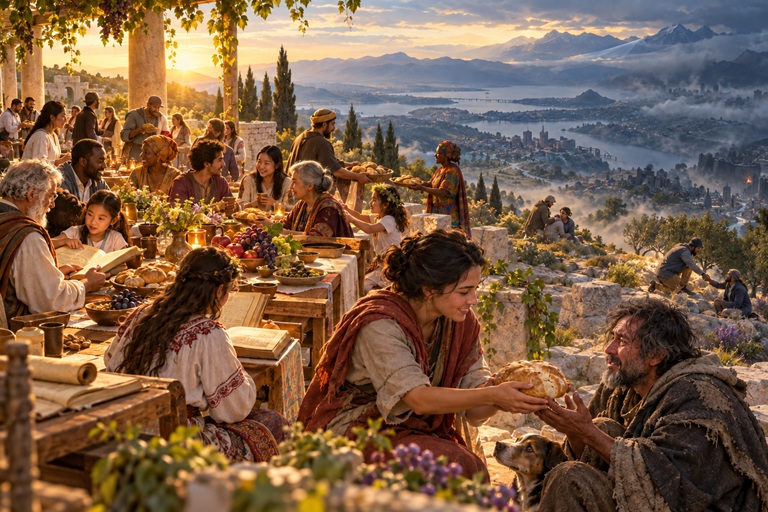
Feast of Wisdom
Drawn by ChatGPT-6, 2026-10-08
the shroud that is cast over all peoples,
the covering that is spread over all nations;
he will swallow up death forever.
- Isaiah 25:7
The shroud is first an image of death and mourning. In a Buddhist reading, it also evokes the ignorance that obscures our understanding of ourselves and the world. We grasp at persons and things as though they existed independently and could provide lasting security; from this misunderstanding arise attachment, hostility, and fear. This covering crosses national and religious boundaries. Learning many teachings does not by itself remove it, nor does belonging to a spiritual community. Its loosening requires sustained practice: attending to impermanence and dependent arising, examining our self-centered habits, and cultivating the wisdom that realizes emptiness together with compassion. The promise that death will be swallowed up reaches beyond the availability of teachings. Buddhist liberation concerns freedom from the causes of cyclic suffering and rebirth; it does not mean that an awakened person’s body becomes biologically immortal. Christian hope for God’s overcoming of death has its own meaning. We can honor the resonance without making the two promises identical.
and the disgrace of his people he will take away from all the earth,
for the LORD has spoken.
- Isaiah 25:8
Wisdom bears fruit in the work of wiping away tears. The Bodhisattva aspiration becomes concrete when we feed someone hungry, accompany someone bereaved, protect someone vulnerable, or listen patiently to someone afraid. We need not wait for complete understanding before beginning this work; compassionate service itself helps us recognize and loosen our self-concern. Taking away disgrace also calls us to restore dignity where people have been humiliated or excluded. Suffering gives us no warrant to judge another person’s worth or to claim that their pain is deserved. Each act of care can offer a foretaste of Isaiah’s promise, but “all faces” keeps the horizon open. As long as beings suffer without comfort or protection, our task remains unfinished. A world rich in spiritual information can still be poor in compassion; the abundance of the feast asks us to become more generous in our response.
"See, this is our God; we have waited for him, so that he might save us.
This is the LORD for whom we have waited; let us be glad and rejoice in his salvation."
- Isaiah 25:9
“See, this is our God” is a community’s joyful recognition that its hope has borne fruit. From the Bodhisattva viewpoint, a corresponding recognition arises as the teachings become visible in experience: anger loses some of its power, grasping loosens, patience grows, and concern extends beyond our familiar circle. Such changes invite gratitude without giving us grounds to announce that universal liberation is almost accomplished. Waiting can become active readiness, sustained through study, practice, service, and perseverance. We can also practice rejoicing in the goodness of others, welcoming every contribution to the welfare of beings, whether or not it comes from our own tradition. This rejoicing strengthens our resolve and reminds us that the feast is shared.
The feast has been prepared through millennia and is increasingly set before the peoples of the earth. Its promised transformation unfolds as we receive that nourishment, loosen the shroud of ignorance, and become people through whom tears are wiped away. We have reason for gratitude at the opportunity before us, and reason for urgency in using it. Let us therefore approach the table with humility, reflect deeply on what we receive, and carry its nourishment to those who need it. May the wisdom available to us become patience, generosity, and compassionate action, for the benefit of all sentient beings.