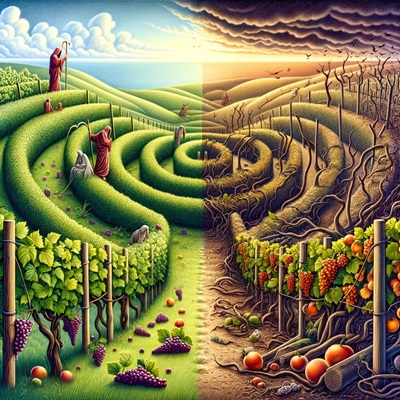
Judgment of the Wild Vineyard
Drawn by DALL·E 3, 2023-11-14
My dear friends,
In today's reading, the prophet Isaiah sings of a vineyard planted with every advantage: fertile ground, carefully prepared soil, choice vines, a watchtower, and a wine vat. Yet the vineyard produces only rotten grapes. Isaiah tells us that the vineyard is the house of Israel. From the viewpoint of the Bodhisattva path, we may also hear this song as a parable of our precious human life. We too have received a rare and fertile field in which the fruits of wisdom and compassion can grow. The question is what we will cultivate in it.
my love song concerning his vineyard:
My beloved had a vineyard
on a very fertile hill.
He dug it and cleared it of stones
and planted it with choice vines;
he built a watchtower in the midst of it
and hewed out a wine vat in it;
he expected it to yield grapes,
but it yielded rotten grapes.
- Isaiah 5:1-2
The precious human life is precious not because human beings are inherently more valuable than other sentient beings, but because this life gives us an unusual combination of freedom and opportunity for spiritual practice. Like Isaiah's vineyard, it has been prepared by causes and conditions we did not create by ourselves. We possess intelligence enough to reflect on our actions, the capacity to recognize suffering in ourselves and others, and opportunities to hear and practice teachings that can transform the mind. These are the fertile soil, the choice vines, the watchtower, and the wine vat of our human life.
What more was there to do for my vineyard that I have not done in it?
When I expected it to yield grapes, why did it yield rotten grapes?
- Isaiah 5:3-4
The owner's question—“What more was there to do for my vineyard that I have not done in it?”—turns our attention from what we have been given to what we do with it. Karma is not fate imposed upon us; it is the principle that intentional actions have consequences. Favorable conditions do not guarantee good fruit. A precious human life becomes spiritually fruitful only as we use it to cultivate generosity, ethical conduct, patience, joyful effort, concentration, and wisdom. The conditions make practice possible; our choices determine what grows from them.
I will remove its hedge, and it shall be devoured;
I will break down its wall, and it shall be trampled down.
I will make it a wasteland;
it shall not be pruned or hoed, and it shall be overgrown with briers and thorns;
I will also command the clouds that they rain no rain upon it.
- Isaiah 5:5-6
Isaiah's threatened destruction of the vineyard can sound like punishment inflicted by an angry owner. Read through the contemplation of impermanence, however, it also describes what inevitably happens to the conditions on which we depend. The hedge will not protect us forever. The wall will fall. The rain will cease. Health, opportunity, companions, teachers, and finally life itself are impermanent. The teaching of precious human life is therefore inseparable from urgency: because these favorable conditions will not last, the time to cultivate the mind and heart is now.
and the people of Judah are his cherished garden;
he expected justice, but saw bloodshed;
righteousness but heard a cry!
- Isaiah 5:7
Isaiah finally tells us what fruit the owner sought: justice and righteousness. The Bodhisattva path likewise measures spiritual cultivation by the fruit it bears for sentient beings. Meditation, study, and devotion are not ends in themselves. Their fruit is a mind less governed by self-cherishing and a life increasingly shaped by wisdom and compassion. If our practice leaves suffering around us unanswered, the vineyard has not yet produced the fruit for which its favorable conditions were given.
So Isaiah's song invites us to look upon this precious human life as a vineyard entrusted to our care. We did not create all the causes and conditions that made it possible, and we cannot preserve them indefinitely. But while they remain, we can cultivate them. May we not allow this fertile field to become overgrown with the habits of craving, aversion, and indifference. May we use it to grow the good fruit of wisdom, compassion, justice, and loving concern for all sentient beings.