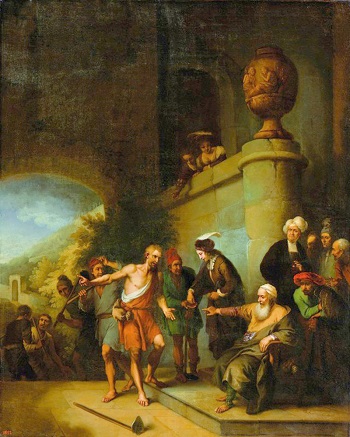
Parable of the Workers in the Vineyard
Christian Wilhelm Ernst Dietrich, ca. 1752
My dear friends,
To comprehend the full meaning of the parable of the laborers in the vineyard, as told in Matthew 20:1-16, we need to consider it in light of its preceding context:
and the last will be first."
- Matthew 19:30
The saying overturns the ordinary arithmetic by which we measure spiritual worth. On the Bodhisattva path, being “first” can become another object of self-grasping: I have practiced longer, sacrificed more, understood more, or served more faithfully. Jesus prepares us to release that ledger. The Awakening Mind, the “mind of Christ,” rejoices whenever any being enters the way of liberation, whether early or late, and seeks no privileged place for itself. To become last is to loosen our demand for precedence and to place the welfare and awakening of others before the claims of the self.
who went out early in the morning
to hire laborers for his vineyard."
- Matthew 20:1
The vineyard can be contemplated as the field of awakening in which love, compassion and wisdom are cultivated for the sake of all beings. The kingdom of heaven is therefore revealed as a way of being together under the rule of boundless generosity. Its measure is bodhicitta rather than competition. We enter this vineyard whenever we accept the call to transform our own mind and to labor for the freedom of others.
When he went out about nine o'clock, he saw others standing idle in the marketplace,
and he said to them, 'You also go into the vineyard,
and I will pay you whatever is right.' So they went.
When he went out again about noon and about three o'clock, he did the same.
And about five o'clock he went out and found others standing around,
and he said to them, 'Why are you standing here idle all day?'
They said to him, 'Because no one has hired us.'
He said to them, 'You also go into the vineyard.'"
- Matthew 20:2-7
The landowner keeps returning. This repeated going-out beautifully evokes the tireless activity of great compassion. Buddhas and bodhisattvas do not abandon beings because they have failed to begin early, and Christ continues to call those whom the world has left standing unwanted in the marketplace. The words “because no one has hired us” invite special tenderness: some beings come late because conditions, wounds, ignorance or exclusion have delayed them. Skillful means meet each person where that person actually stands. Our task is therefore to answer the call when we hear it, and then to help create the conditions in which others can answer it too.
'Call the laborers and give them their pay,
beginning with the last and then going to the first.'"
- Matthew 20:8
The order of payment makes the teaching visible. The last are brought forward so that everyone can witness a generosity that exceeds the customary calculation of merit and reward. In Mahayana practice, we similarly dedicate whatever virtue we accumulate to the awakening of all beings rather than guarding it as private spiritual property. The landowner’s instruction asks us to imagine a community in which another person’s good fortune is received as good news for us as well.
Now when the first came, they thought they would receive more;
but each of them also received a denarius."
- Matthew 20:9-10
The denarius points toward a gift whose fullness cannot be divided according to hours worked. Awakening is not a larger possession for the person who has practiced longest; the boundless nature of wisdom and compassion does not diminish when another shares in it. Likewise, divine grace is not depleted by generosity. The early laborers receive everything promised to them, yet comparison converts sufficiency into disappointment. In contrast, when another receives happiness, recognition or spiritual benefit, we should practice sympathetic joy and let that happiness enlarge our own heart.
'These last worked only one hour, and you have made them equal to us
who have borne the burden of the day and the scorching heat.'"
- Matthew 20:11-12
The workers' complaint exposes a subtle danger of sincere practice. Long effort can quietly generate the thought, “After all I have endured, I deserve more.” Once this thought hardens, service becomes a transaction and virtue becomes a basis for ranking ourselves above others. The Bodhisattva path asks us to notice such movements without condemnation and to apply the antidote of exchanging self and others: may the hardship I have borne deepen my compassion for those who still suffer; may whatever strength I have gained become useful to them. Then the scorching heat itself becomes part of the path.
'Friend, I am doing you no wrong; did you not agree with me for a denarius?
Take what belongs to you and go;
I choose to give to this last the same as I give to you.
Am I not allowed to do what I choose with what belongs to me?
Or are you envious because I am generous?'"
- Matthew 20:13-15
The landowner calls the grumbler “Friend.” Even the jealous mind is addressed without rejection. His question, “Are you envious because I am generous?” turns our attention inward, where the real spiritual work lies. When another receives mercy, opportunity or joy, what arises in us? The self-cherishing mind experiences another’s gain as its own loss; bodhicitta experiences another’s gain as fulfillment of its deepest wish. Jesus’ generosity and the Bodhisattva vow meet here: may every being receive the causes and conditions of complete happiness, whether or not I receive distinction for helping.
- Matthew 20:16
The closing saying now carries the weight of the whole parable. “First” and “last” are categories created by comparison, and the kingdom loosens our attachment to them. A bodhisattva willingly takes the lower place when doing so serves beings, while also recognizing that in emptiness there is no fixed, independently existing first person, last person, superior practitioner or inferior practitioner. Conventional differences remain, yet they provide no foundation for pride. The more deeply we awaken, the more naturally we rejoice that those who seemed last are welcomed into the same boundless good.
My dear friends, the parable asks us to examine what kind of heart we bring into the vineyard. We may have labored through many years of prayer, meditation, ethical discipline and service. Let that long labor ripen into greater generosity rather than a claim to greater reward. When someone arrives at the eleventh hour, let us rejoice that another precious being has heard the call. Practice this teaching whenever comparison arises. Notice how the heart contracts if we say, “Why should they receive what I receive?” Then breathe into the mind of Christ, the Awakening Mind of bodhicitta, and reverse the equation: “How wonderful that they too receive what brings life. May every being receive it.” In this way envy becomes a bell of mindfulness, calling us back to sympathetic joy.
The vineyard is vast, the suffering of beings is immeasurable, and the compassionate call continues throughout the day. Whether we came at dawn or near evening, there is work of love before us. May we undertake it without keeping accounts, dedicate its fruits to all beings, and rejoice whenever the last are welcomed as the first. Thus we learn to inhabit the kingdom of heaven: receiving grace gratefully, giving ourselves freely, and desiring awakening for everyone without exception.